Get Mvt 103 Form in PDF
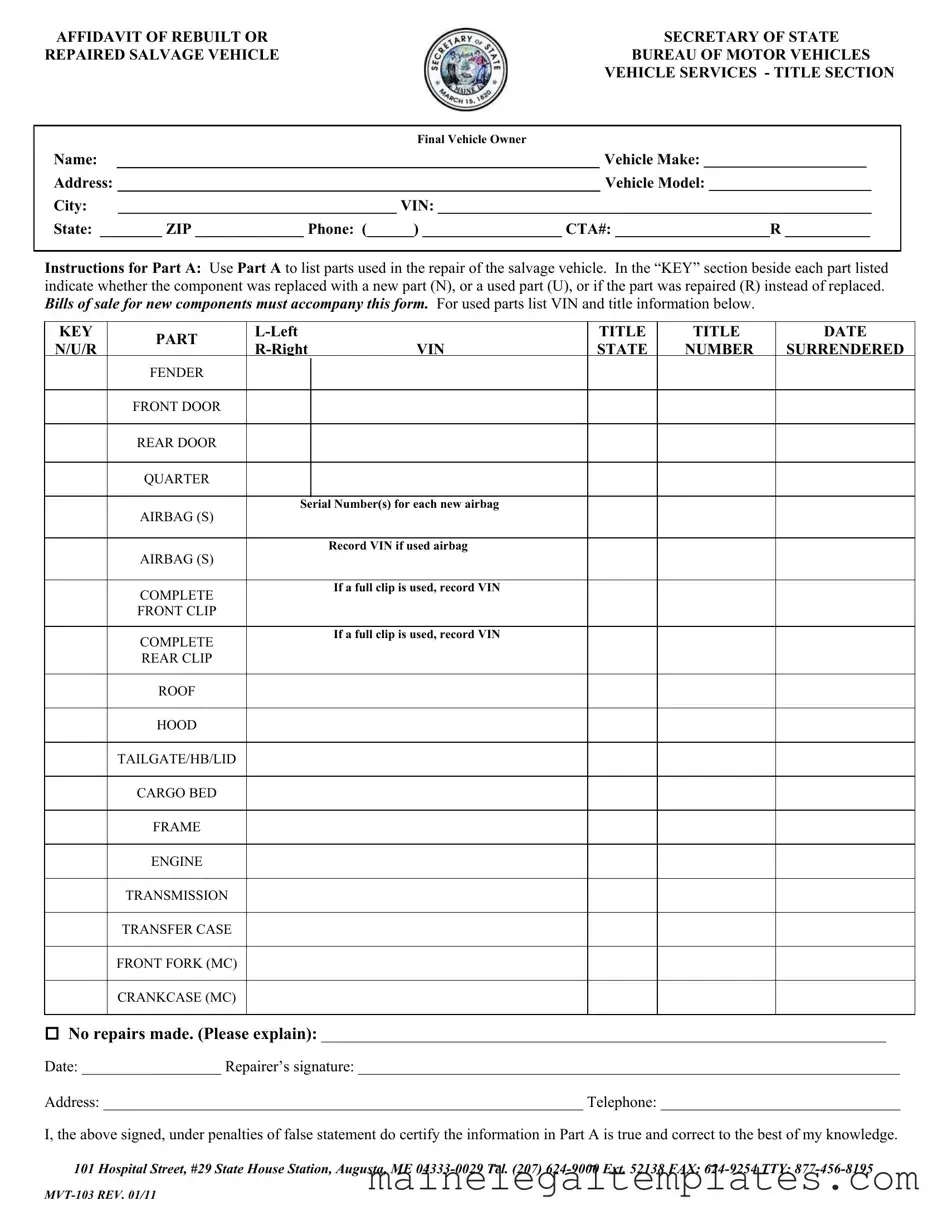
The Mvt 103 form plays a crucial role in the process of managing salvage vehicles in the state of Maine. This form is divided into two main parts: Part A and Part B, each serving a specific purpose. In Part A, vehicle owners or repairers must provide detailed information about the components used in the repair of a salvage vehicle. This includes listing whether each part was replaced with a new part, a used part, or repaired. Accompanying bills of sale for new components are required, ensuring transparency in the vehicle's restoration. On the other hand, Part B is used to notify the Secretary of State when a salvage vehicle has been scrapped, dismantled, or destroyed. This section emphasizes the importance of surrendering the vehicle's title promptly, even if the title is from another state. The Mvt 103 form is essential for maintaining accurate records of salvage vehicles, ensuring compliance with state regulations, and protecting the interests of vehicle owners and repairers alike.
Dos and Don'ts
When filling out the Mvt 103 form, it is important to follow specific guidelines to ensure accuracy and compliance. Here are four things you should and shouldn't do:
- Do provide complete and accurate information in all fields.
- Do include bills of sale for any new parts listed in Part A.
- Don't leave any sections blank; ensure all required information is filled in.
- Don't forget to sign and date the form before submission.
Key takeaways
When dealing with the MVT 103 form, here are some key takeaways to keep in mind:
- Understand the Purpose: The MVT 103 form is used for declaring a vehicle as rebuilt or for reporting its scrapping or destruction.
- Complete All Sections: Ensure that every section of the form is filled out completely, including owner details, vehicle information, and repair specifics.
- Part A for Repairs: Use Part A to list all parts used in the repair of the salvage vehicle. Be clear about whether parts are new, used, or repaired.
- Documentation Required: Attach bills of sale for any new parts included in the repairs. This is crucial for validation.
- VIN Information: If used parts are installed, provide the VIN and title information for those components.
- Title Surrender: You must surrender the title of the salvage vehicle when any component is removed or if the vehicle is scrapped.
- Certification Requirement: The person completing the form must certify that the information provided is true and correct, under penalties of false statement.
- Signature Needed: The repairer’s signature is required in Part A, while Part B also requires a signature for title surrender.
- Keep Copies: Always keep copies of the completed form and any attached documents for your records.
Filling out the MVT 103 form correctly ensures compliance and helps avoid potential legal issues down the line.
Instructions on Filling in Mvt 103
Completing the MVT 103 form is a necessary step for individuals dealing with salvage vehicles. This process involves providing detailed information about the vehicle and the repairs made, or indicating if the vehicle has been scrapped or destroyed. Following the instructions carefully ensures compliance with state regulations.
- Begin by filling out the final vehicle owner’s name in the designated space at the top of the form.
- Next, enter the vehicle make and model in the appropriate fields.
- Provide the vehicle's address, including city, state, and ZIP code.
- Record the Vehicle Identification Number (VIN) in the specified area.
- Include your phone number and CTA# if applicable.
- In Part A, list all parts used in the repair of the salvage vehicle. For each part, indicate whether it was replaced with a new part (N), a used part (U), or repaired (R).
- Attach bills of sale for any new components used in the repairs.
- If used parts were employed, provide the VIN and title information in the designated area.
- For each airbag installed, record the serial number, and if used, include the VIN of the airbag.
- If a full clip was used, document the VIN for both the front and rear clips.
- Complete the section for any other parts, such as the hood, tailgate, or engine.
- If no repairs were made, provide an explanation in the space provided.
- Sign and date the form, certifying that the information provided is true and correct.
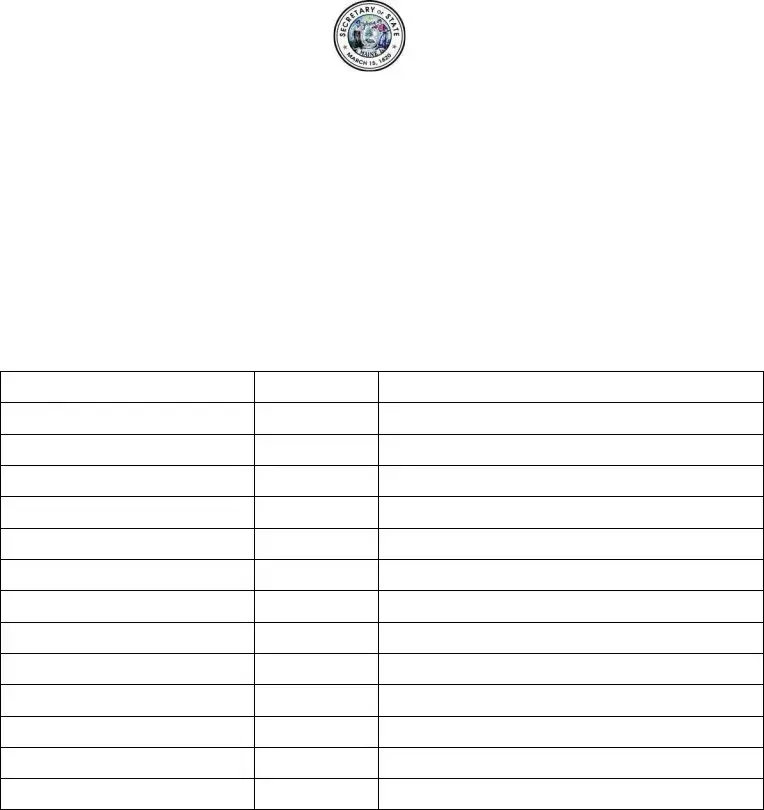
- In Part B, if applicable, surrender the title of the salvage vehicle by filling in your name, address, and the title number, along with the state and VIN.
- Certify that the vehicle has been scrapped, dismantled, compressed, or destroyed by signing and dating this section as well.
- Ensure that your name appears on the back of every surrendered title or on a transfer form attached to the title.
Find Popular Forms
Motion to Enforce - Any new legal matters regarding the children should be reported in detail.
Obtaining an Emotional Support Animal Letter is essential for individuals who benefit from the presence of their emotional support animal, as it legitimizes their need for assistance and companionship. This important document can often be accessed through reputable services, such as topformsonline.com/, ensuring that individuals receive the support they require to enhance their mental well-being.
Wheres My Refund Maine - Understanding the tax obligation will aid in better financial planning during a property sale or purchase.
Learn More on This Form
-
What is the purpose of the Mvt 103 form?
The Mvt 103 form is utilized for documenting the repair or rebuilding of salvage vehicles in the state of Maine. It serves two main functions: Part A is used to list the parts that have been replaced or repaired in the vehicle, while Part B is for notifying the Bureau of Motor Vehicles when a salvage vehicle has been scrapped, dismantled, compressed, or destroyed.
-
Who needs to complete the Mvt 103 form?
Individuals or companies that have repaired or rebuilt a salvage vehicle must complete Part A of the Mvt 103 form. Additionally, anyone who has scrapped or destroyed a salvage vehicle must fill out Part B. This ensures that the state has accurate records of the vehicle's status and history.
-
What information is required in Part A of the form?
Part A requires detailed information about the parts used in the repair of the salvage vehicle. This includes:
- The vehicle's make, model, and VIN.
- A list of parts that were replaced, repaired, or were already used, along with the corresponding status indicated as new (N), used (U), or repaired (R).
- Supporting documentation, such as bills of sale for new components and VIN/title information for any used parts.
-
What should be done with the title of a salvage vehicle?
According to the instructions in Part B, the title of a salvage vehicle must be surrendered to the Maine Bureau of Motor Vehicles as soon as any component part is removed or when the vehicle is scrapped, compressed, or destroyed. This applies even if the title originates from another state.
-
What are the penalties for providing false information on the Mvt 103 form?
Under penalties of false statement, individuals who certify incorrect information on the Mvt 103 form may face legal consequences. This includes potential fines or other penalties for submitting false information regarding the status of the vehicle or the parts used in its repair.
File Attributes
| Fact Name | Details |
|---|---|
| Form Purpose | The MVT 103 form is used for documenting the repair or rebuilding of salvage vehicles in Maine. |
| Part A Usage | Part A is specifically for listing parts used in the repair process and requires details on whether parts are new, used, or repaired. |
| Title Surrender Requirement | Title must be surrendered to the Maine Bureau of Motor Vehicles when a salvage vehicle is scrapped, dismantled, or destroyed. |
| Certification | The signer certifies the accuracy of the information provided under penalties of false statement. |
| Contact Information | The form provides contact details for the Maine Bureau of Motor Vehicles for any inquiries. |
| Governing Law | This form is governed by Maine state law regarding salvage vehicles and their repair documentation. |
| Signature Requirement | A signature is required from the person or company surrendering the title, confirming the vehicle's status. |
Documents used along the form
The Mvt 103 form is essential for documenting the repair or rebuilding of a salvage vehicle. Alongside this form, several other documents are commonly required to ensure compliance with state regulations. Below is a list of these forms, each serving a specific purpose in the process.
- Title Application Form: This form is used to apply for a new title after a vehicle has been rebuilt. It provides necessary information about the vehicle and the new owner.
- Bill of Sale: A bill of sale serves as proof of the transaction between the buyer and seller. It should include details about the vehicle, such as the VIN and sale price.
- Bill of Sale: A bill of sale serves as proof of the transaction between the buyer and seller of a salvage vehicle. This form outlines important details such as the vehicle's condition, price, and the parties involved, helping to establish ownership. For a template, you can refer to https://nyforms.com/bill-of-sale-template.
- Salvage Title: This document is issued when a vehicle is declared a total loss by an insurance company. It must be surrendered when applying for a rebuilt title.
- Inspection Certificate: After repairs, an inspection certificate confirms that the vehicle meets safety and operational standards. This is often required before a new title is issued.
- Affidavit of Ownership: This affidavit may be necessary if the vehicle's ownership is unclear. It helps establish legal ownership when applying for a new title.
- Insurance Documents: Proof of insurance is often required to ensure that the vehicle is covered before it can be registered again.
Gathering these documents can simplify the process of obtaining a rebuilt title for your salvage vehicle. Ensure all forms are completed accurately to avoid delays in processing.
Misconceptions
Misconceptions about the Mvt 103 Form
- It’s only for rebuilt vehicles. Many believe the Mvt 103 form is exclusively for vehicles that have been rebuilt. In reality, it also applies to vehicles that have been scrapped or dismantled.
- Only professional mechanics can fill it out. While mechanics often handle repairs, anyone who has repaired or scrapped a vehicle can complete the form. It’s important that the information provided is accurate, regardless of who fills it out.
- You don’t need to provide receipts for parts. Some think receipts are unnecessary, but bills of sale for new parts must accompany the form. This documentation helps verify that the repairs were legitimate.
- Used parts don’t require documentation. This is a common error. When using used parts, you must list the VIN and title information. Transparency is crucial for the process.
- Submitting the form is optional. Many people mistakenly believe that submitting the Mvt 103 is optional. However, you must surrender the title as soon as you remove any component part or if the vehicle is scrapped.
- It’s only relevant for vehicles with a salvage title. Some individuals think the form only applies to vehicles already labeled as salvage. However, it’s also relevant for vehicles that are declared a total loss by insurance.
- Once submitted, the process is complete. Submitting the Mvt 103 does not finalize the vehicle's status. Additional steps may be necessary, such as obtaining a new title or registration.
- The form is the same in every state. Each state has its own regulations and forms. While the Mvt 103 is specific to Maine, other states may have different requirements for salvage vehicles.
- It’s a quick and easy process. Many underestimate the complexity involved. Filling out the Mvt 103 accurately requires attention to detail and can take time, especially if there are complications with the vehicle's history.
Document Preview

AFFIDAVIT OF REBUILT OR |
SECRETARY OF STATE |
REPAIRED SALVAGE VEHICLE |
BUREAU OF MOTOR VEHICLES |
|
VEHICLE SERVICES - TITLE SECTION |
|
|
|
Final Vehicle Owner |
Name: ____________________________________________________ Vehicle Make: _____________________
Address: ____________________________________________________ Vehicle Model: _____________________
City: ____________________________________ VIN: ________________________________________________________
State: ________ ZIP ______________ Phone: (______) __________________ CTA#: ____________________R ___________
Instructions for Part A: Use Part A to list parts used in the repair of the salvage vehicle. In the “KEY” section beside each part listed indicate whether the component was replaced with a new part (N), or a used part (U), or if the part was repaired (R) instead of replaced. Bills of sale for new components must accompany this form. For used parts list VIN and title information below.
KEY |
PART |
|
TITLE |
TITLE |
DATE |
||
N/U/R |
VIN |
STATE |
NUMBER |
SURRENDERED |
|||
|
|||||||
|
FENDER |
|
|
|
|
|
|
|
|
|
|
|
|
||
|
|
|
|
|
|
|
|
|
FRONT DOOR |
|
|
|
|
|
|
|
|
|
|
|
|
|
|
|
REAR DOOR |
|
|
|
|
|
|
|
|
|
|
|
|
|
|
|
QUARTER |
|
|
|
|
|
|
|
|
|
|
|
|
|
|
|
|
Serial Number(s) for each new airbag |
|
|
|
||
|
AIRBAG (S) |
|
|
|
|
|
|
|
|
|
|
|
|
|
|
|
|
|
Record VIN if used airbag |
|
|
|
|
|
AIRBAG (S) |
|
|
|
|
|
|
|
|
|
|
|
|
|
|
|
COMPLETE |
|
If a full clip is used, record VIN |
|
|
|
|
|
|
|
|
|
|
||
|
FRONT CLIP |
|
|
|
|
|
|
|
|
|
|
|
|
|
|
|
COMPLETE |
|
If a full clip is used, record VIN |
|
|
|
|
|
|
|
|
|
|
||
|
REAR CLIP |
|
|
|
|
|
|
|
|
|
|
|
|
|
|
|
ROOF |
|
|
|
|
|
|
|
|
|
|
|
|
|
|
|
HOOD |
|
|
|
|
|
|
|
|
|
|
|
|
|
|
|
TAILGATE/HB/LID |
|
|
|
|
|
|
|
|
|
|
|
|
|
|
|
CARGO BED |
|
|
|
|
|
|
|
|
|
|
|
|
|
|
|
FRAME |
|
|
|
|
|
|
|
|
|
|
|
|
|
|
|
ENGINE |
|
|
|
|
|
|
|
|
|
|
|
|
|
|
|
TRANSMISSION |
|
|
|
|
|
|
|
|
|
|
|
|
|
|
|
TRANSFER CASE |
|
|
|
|
|
|
|
|
|
|
|
|
|
|
|
FRONT FORK (MC) |
|
|
|
|
|
|
|
|
|
|
|
|
|
|
|
CRANKCASE (MC) |
|
|
|
|
|
|
|
|
|
|
|
|
|
|
No repairs made. (Please explain): _________________________________________________________________________
Date: __________________ Repairer’s signature: ______________________________________________________________________
Address: ______________________________________________________________ Telephone: _______________________________
I, the above signed, under penalties of false statement do certify the information in Part A is true and correct to the best of my knowledge.
101 Hospital Street, #29 State House Station, Augusta, ME
DISPOSITION OF SALVAGE VEHICLE |
SECRETARY OF STATE |
|
BUREAU OF MOTOR VEHICLES |
|
VEHICLE SERVICES - TITLE SECTION |
PART B |
|
NOTICE: You must surrender the title of a salvage vehicle to the Maine Bureau of Motor Vehicles as soon as you remove any component part as listed in Part A of the reverse of this form, or as soon as a salvage vehicle is scrapped, compressed or destroyed, even if the title is from another state.
INSTRUCTIONS: Use Part B to inform the Secretary of State that a salvage vehicle has been scrapped, dismantled, compressed or destroyed. (If the salvage vehicle has been rebuilt use Part A on the reverse of this form.) A salvage vehicle is any vehicle for which an insurance company has made a total loss payoff or which an owner declares is only useful for parts.
PERSON OR COMPANY SURRENDERING TITLE (S)
NAME______________________________________________________________________________________
ADDRESS __________________________________________________________________________________
TITLES SURRENDERED
TITLE NUMBER
STATE
VIN
Under penalties of false statement, I, the undersigned, certify that the vehicles described in the attached certificates of title were scrapped, dismantled, compressed or destroyed.
Signature: ____________________________________________________________________ Date: ____________________________
Note: Make sure your name is on the back of every surrendered title or on a transfer form attached to the title.
101 Hospital Street, #29 State House Station, Augusta, ME